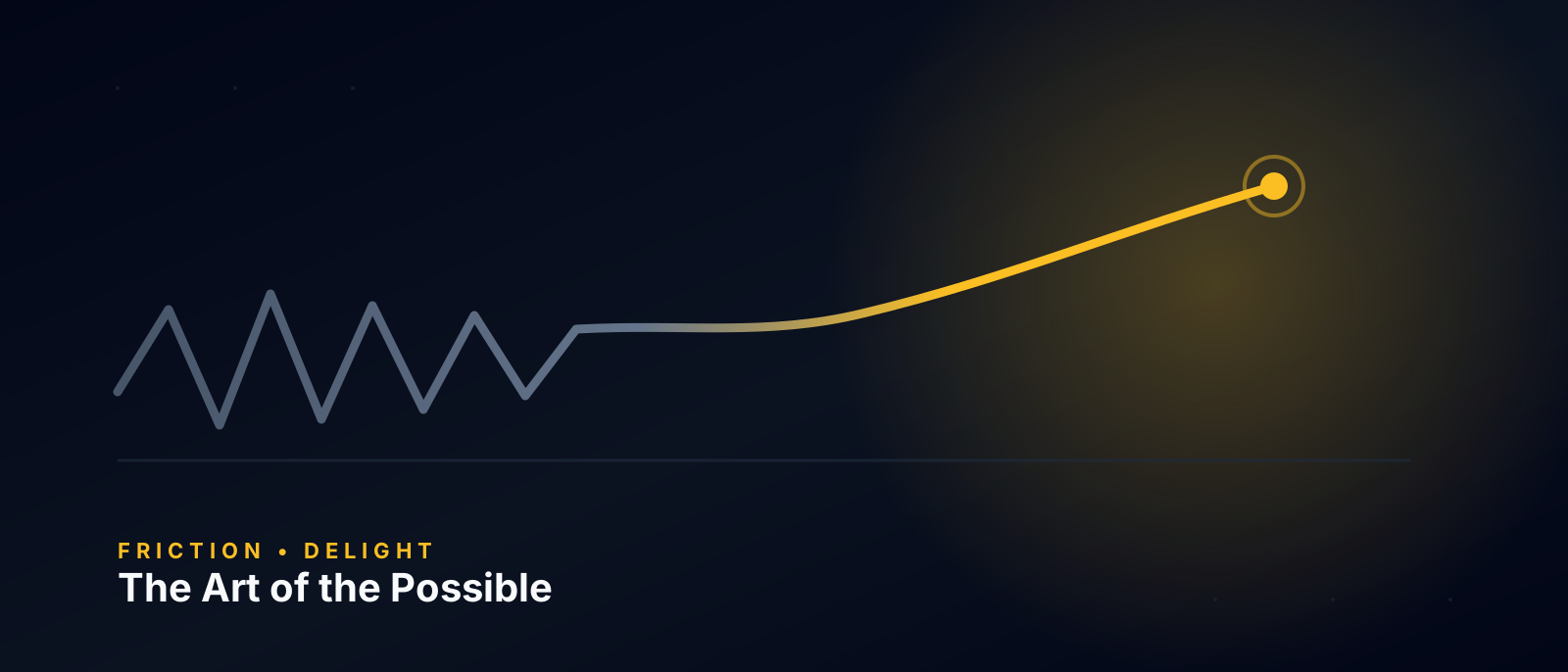
Friction, Delight, and the Art of the Possible
If you ask ten product-led growth teams what their job is, nine of them will say "remove friction." It is the right answer to a much smaller question than the one they think they are answering.
Removing friction is necessary. It is also nowhere near sufficient. A perfectly frictionless product that nobody pays for is not a PLG win. It is a free service that happens to have a billing page no one ever sees.
The teams that actually grow revenue through the product, rather than around it, are running three jobs at once.
Job one: remove every friction the user did not ask for
This is the table stakes job. Sign-up that takes thirty seconds. A first deploy that does not require a credit card. Documentation that loads in the same tab. SSO that works the first time. Defaults that are right for the ninety percent case so the user is not asked to make a decision they cannot yet make.
Most PLG playbooks stop here. That is the trap. Removing friction is a hygiene activity. It does not, on its own, produce a single dollar of revenue. It produces the conditions under which revenue becomes possible.
A user who never feels resistance also never feels graduation. If everything is free and everything is easy, there is no moment where the product earns the right to be paid for.
Job two: show delight, repeatedly
Delight is the part most teams undermeasure and underbuild. It is the small cumulative experience of the product doing something the user expected to be hard, and doing it well. The deploy that just worked. The error message that already had the answer. The integration that was one click instead of an afternoon.
These moments are not features. They are the byproduct of obsessively engineered defaults, and they compound. A user who has been delighted four times in two weeks is in a fundamentally different posture toward the product than one who has been merely served. The first user is looking for more reasons to use the product. The second is looking for reasons to leave.
This matters commercially because delight is what makes the next conversation possible. You cannot sell security, scale, or advanced collaboration to a user who has not yet decided your product is the centre of their workflow. You can sell those things easily, almost effortlessly, to a user who already cannot imagine working without it.
Job three: educate the user on the art of the possible
This is the job that is missing from almost every PLG motion I see at scale. The user is in the product. They are happy. They are using it for one thing. They have no idea you can do the next eight.
The opportunity, and it is enormous, is to keep showing the user what is possible. Not in a marketing email. In the product. At the moment of relevance. "You just deployed three sites this week, here is what teams who run ten do differently." "You are reading this log line, here is the dashboard that surfaces them automatically." "You are pasting this token by hand, here is the SSO flow that handles it for you."
Education in this form is not a feature, and it is not marketing. It is a continuous, low-volume conversation between the product and the user about what the user could be getting next. Done well, it is the engine that turns delight into expansion.
Where value extraction belongs
This is the operational point most PLG teams get wrong, and it is where the three jobs come together. The instinct, when revenue is needed, is to install a friction wall. "You have used three deploys. Pay now." That is the opposite of PLG. That is a paywall pretending to be a product.
The right place to extract value is the moment of revealed need. Security, when the user starts handling something sensitive. Scale, when they cross the threshold where the free posture stops being sustainable. Collaboration, when the second person joins. Compliance, when the user is suddenly negotiating with their procurement team and needs the answer.
These moments are not friction. They are graduation. The user is not being blocked, they are being recognised. They have earned the right to want the next thing, and the product is meeting them there.
The difference between a friction wall and a graduation moment is not the price. It is the timing and the framing. A team that knows the difference can charge for the same feature and have the user thank them for it. A team that does not will run a free service and wonder where the revenue went.
Why this is the whole job
PLG is not a single instruction. It is a discipline of running three jobs in parallel. Remove the friction the user did not ask for. Engineer the delight that earns the next conversation. Educate the user on the next thing the product could do for them. And then, when the user reveals a real need, be ready to charge for it without apology.
The teams that do this well are quiet about it. The friction work is invisible when it is done right. The delight work looks like the product just being good. The education work feels like the product being thoughtful. The revenue, when it arrives, looks like it was always going to.
The teams that do not do this well will keep saying "remove friction" and keep wondering why the dashboard is green and the bookings are not.